
What Are “Defaults” — And Why They Matter in Your Relationship
Feb 16, 2026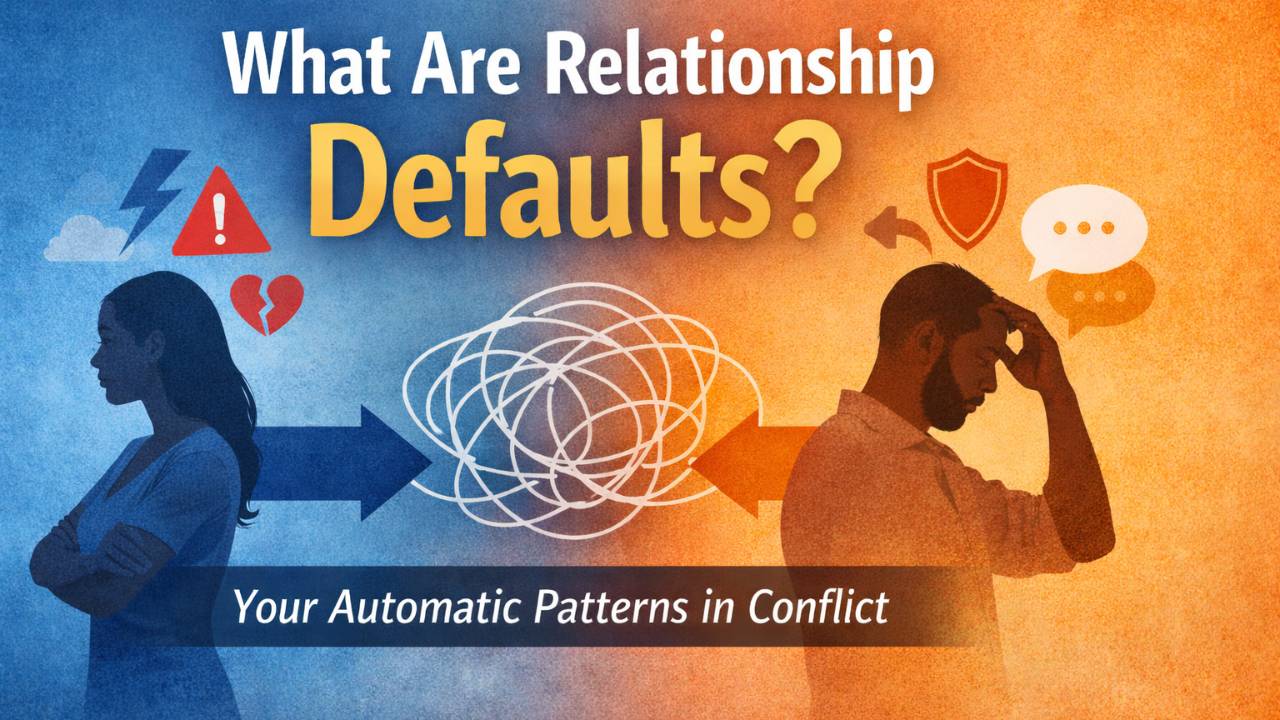
What Are “Defaults” — And Why They Matter in Your Relationship
Most couples think their biggest problem is communication.
But what if the real issue isn’t what you’re saying — it’s what you’re automatically bringing into the conversation?
In the Stormproof framework, we call this Defaults.
Defaults are the patterns that show up before you even try. They’re your emotional wiring, stress responses, attachment tendencies, personality traits, and past experiences. They’re not choices. They’re habits your nervous system learned long before this relationship began.
And when two people bring two different sets of defaults into one relationship, things can get complicated.
What Defaults Look Like in Real Life
Defaults show up as:
-
Feeling misunderstood even when you’re trying to explain
-
Overreacting to small things
-
Shutting down during conflict
-
Escalating quickly when emotions rise
-
Pulling away when things feel tense
-
Clinging harder when you feel distance
-
Repeating the same arguments over and over
-
Feeling constantly on guard
These reactions often feel intentional to the other person.
But they usually aren’t.
They’re automatic.
Why This Matters
When couples don’t understand defaults, they personalize everything.
One partner thinks:
“You’re overreacting.”
The other thinks:
“You never listen.”
But what’s often happening is:
-
One nervous system goes into fight.
-
The other goes into flight.
-
Both feel unsafe.
-
Both think the other started it.
Without understanding defaults, couples try to fix behavior instead of understanding the pattern underneath it.
And that rarely works.
The Real Shift
Understanding defaults doesn’t mean excusing harmful behavior.
It means recognizing:
-
Some reactions are protective.
-
Some withdrawal is overwhelm.
-
Some defensiveness is fear.
-
Some escalation is stress.
When couples can say,
“This is my default showing up,”
instead of,
“This is your fault,”
everything changes.
Blame lowers.
Curiosity increases.
Progress becomes possible.
The Goal Isn’t Perfection
You don’t eliminate defaults.
You become aware of them.
Because once you can see them, you can slow them down.
And once you can slow them down, you can choose differently.
That’s where real relationship growth begins.